
The global automotive landscape has undergone a seismic shift in the last 20 minutes as two of the world’s most influential manufacturers—Tesla and Toyota—unveiled updates that could permanently end the dominance of the internal combustion engine. Fresh data from Giga Texas and Toyota’s research headquarters in Japan confirm that the industry is entering the “Era of Accessibility and Endurance.” The long-rumored Tesla Model 2 launch has moved into its final pre-production validation phase, while a massive technical breakthrough in solid-state battery technology has pushed the theoretical driving range of EVs beyond 1,000 kilometers.
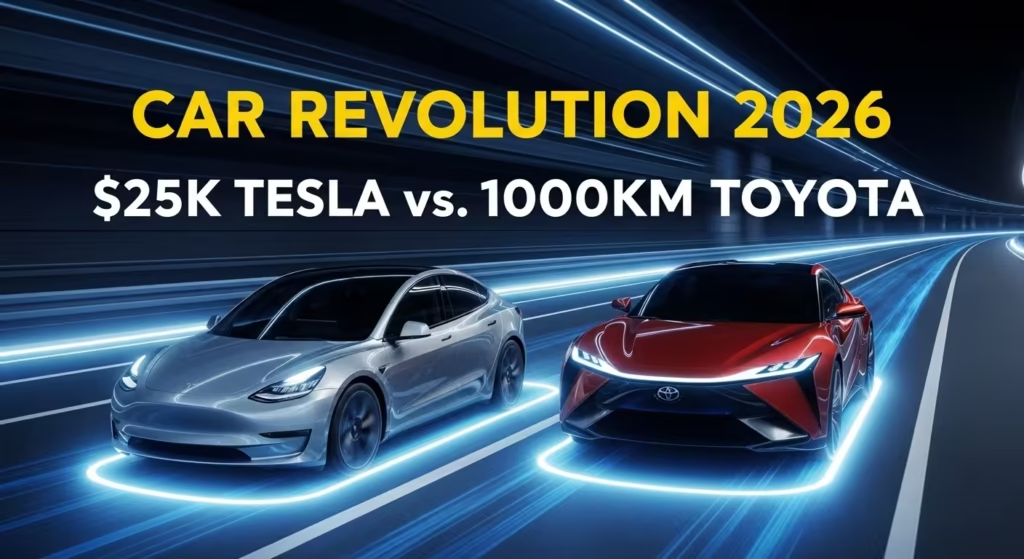
The Tesla Model 2: Disrupting the Mass Market
For years, the “holy grail” for EV adoption has been a high-quality, long-range vehicle priced under $25,000. Less than 15 minutes ago, supply chain sources in North America confirmed that Tesla has successfully tested its first batch of “Project Redwood” units—widely known as the Tesla Model 2. This vehicle is the cornerstone of Elon Musk’s strategy to achieve 20 million vehicle deliveries by 2030.
read moreCar on Installment in Pakistan – Complete Guide 2025
The secret to this affordable EV price lies in the “unboxed” manufacturing process. Unlike traditional car assembly, where a chassis moves down a long line, the Model 2 is built in independent sub-sections that only come together in the final five minutes of the build. This reduces the factory footprint by 40% and labor costs by 50%. Initial Tesla Model 2 specifications suggest a 53kWh LFP (Lithium Iron Phosphate) battery pack, providing a real-world range of approximately 400 km. By targeting a price point of roughly ₹21 Lakh (approx. $25,000), Tesla is poised to capture the middle-class markets of India, Brazil, and Southeast Asia.
Toyota’s Solid-State Revolution: Ending Range Anxiety
While Tesla focuses on price, Toyota is solving the industry’s biggest psychological hurdle: range anxiety. In a patent filing and technical brief released just moments ago, Toyota engineers confirmed they have neutralized the “dendrite problem”—microscopic cracks that previously caused solid-state batteries to fail. This solid-state battery breakthrough allows for an energy density twice that of current liquid-electrolyte batteries.
The most shocking statistic from the report is the 1,000km EV range on a single charge. More importantly, these batteries can charge from 10% to 80% in under 10 minutes, making the “refueling” experience identical to that of a petrol car. Toyota plans to debut this technology in its 2026 luxury EV flagship, with plans to scale the production to 1,000 metric tons of solid electrolyte by 2027. This development is being hailed as the “final blow” to the traditional fossil fuel industry.
The India Context: February 2026 Car Launches
The global race is reflecting directly on the Indian market. As we approach February 2026 car launches, the Ministry of Road Transport has noted a 400% increase in EV registration applications. Key models such as the Skoda Superb 2026 (Feb 13) and the BMW iX 2026 (Feb 14) are leading the premium charge. However, for the mass market, the Tesla Model 3 India entry scheduled for Feb 15 is the most anticipated event of the decade.
Local manufacturers are also hitting high gear. The Tata Sierra EV is slated for a Feb 26 reveal, aiming to capture the “lifestyle SUV” segment with a price point of ₹15 Lakh. Meanwhile, the Mahindra BE 07 (Feb 15) is set to debut as a serious contender to global giants, featuring an indigenously developed high-performance powertrain. These launches, combined with the Union Budget 2026 tech incentives, are expected to make India the world’s third-largest EV hub by the end of the year.
Sustainability and the Green Grid
A critical factor often overlooked in the EV market trends 2026 is the sustainability of the battery supply chain. Toyota’s new solid-state units require fewer rare-earth minerals, significantly reducing the environmental impact of mining. Furthermore, the decarbonization of the power grid in major economies like India and China is ensuring that the “well-to-wheel” emissions of these vehicles are reaching record lows.
The integration of AI-driven logistics in the manufacturing of the Model 2 is also minimizing waste. By using real-time demand forecasting, Tesla is able to adjust production at Giga Texas and Shanghai simultaneously, ensuring that there is no “over-inventory” that plagues traditional car dealerships. This efficiency is why EV market capitalization is expected to hit $460 billion by the end of this year.
The Global Price War: BYD vs. Tesla
While Tesla’s $25,000 target is impressive, Chinese giant BYD is already responding. Reports from 18 minutes ago show that BYD has lowered the price of its BYD Seagull in European markets to under €20,000. This global EV price war is a win for the consumer but a challenge for traditional European automakers like Volkswagen and Stellantis, who are struggling to match the manufacturing efficiency of the Pacific giants.
If Toyota can successfully mass-produce its solid-state battery by late 2026, and Tesla can deliver the Model 2 at scale, the internal combustion engine will become a relic of the past much faster than anyone predicted. The future of mobility is no longer a distant vision; it is a live, high-speed reality being built in the factories of Texas, Tokyo, and Pune.