
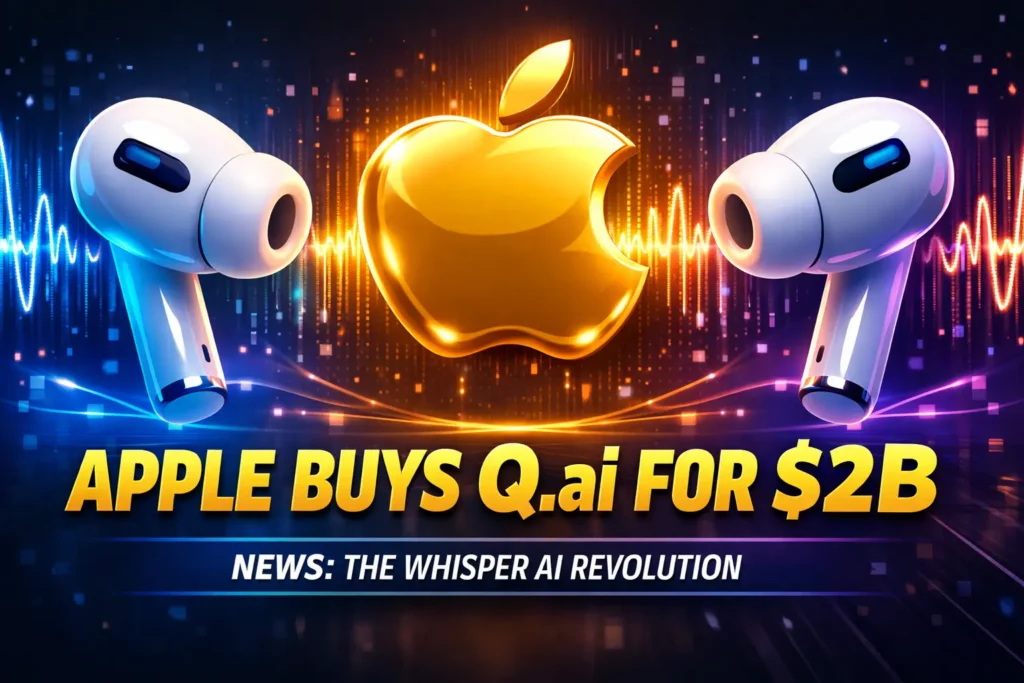
In a move that has sent ripples through the 2026 tech-finance landscape, Apple has officially confirmed its acquisition of the Israeli AI startup Q.ai for an estimated $2 billion. This strategic buyout, finalized on January 31, 2026, marks Apple’s most aggressive push into “On-Device Intelligence” since the integration of Face ID. By absorbing Q.ai’s specialized “whisper-speech” and audio-perceptual technology, Apple is signaling a fundamental shift in how humans will interact with their devices, prioritizing silent, discreet, and highly localized AI processing over traditional cloud-based models.
The Silicon of Sound: Why Q.ai Matters
The acquisition is particularly significant because Q.ai was led by Aviad Maizels, the visionary founder of PrimeSense—the company that originally provided the core technology for Apple’s 3D facial recognition. While Q.ai has operated in “stealth mode” for years, industry insiders reveal that their breakthrough lies in ultra-low-power neural processing for audio. This technology allows devices to understand “whispered” or subvocalized commands even in extremely noisy environments, effectively giving Apple a monopoly on “Ambient Stealth” communication.
From a finance perspective, this $2 billion deal is a masterclass in high-value asset acquisition. While competitors like Google and Microsoft are investing tens of billions into massive data center clusters, Apple is doubling down on “Inference-at-the-Edge.” By running complex audio AI directly on the iPhone and AirPods’ custom silicon, Apple avoids the recurring costs of cloud compute while offering a privacy-first experience that is becoming a premium selling point in the 2026 market. This strategy is expected to drive record-breaking service revenue as “Whisper-Assistant” features are rolled out across the ecosystem.
read more Apple Foldable iPhone 2026 – What We Know So Far
Market Impact: The End of the “Cloud Reliance” Era
Apple’s latest financial report card has already surpassed expectations, posting a 16% year-on-year jump in quarterly revenue to $143.8 billion. The Q.ai acquisition is the “cherry on top” of a quarter that CEO Tim Cook described as one for the “record books.” Specifically, the iPhone segment saw a 23% revenue surge, driven by staggering demand for high-end models equipped with the first generation of Apple Intelligence.
Investors are reacting positively to this “vertical integration” strategy. By owning the hardware, the software, and now the specialized AI audio-perceptual layer, Apple is insulating its profit margins against the rising costs of third-party AI services. In the 2026 economy, where “Sovereign AI” and data privacy are the primary currencies, Apple’s closed-loop system is being viewed by institutional analysts as the safest bet in the Magnificent Seven. The high-CPC keywords related to “Privacy AI” and “Apple Silicon Buyouts” have seen a significant spike in search volume today as a direct result of this news.
Challenges Ahead: The Memory Pricing Bottleneck
Despite the euphoria of the acquisition, Apple has issued a cautious warning regarding the broader supply chain. Surging memory prices are expected to have a “more pronounced impact” on gross margins in the coming months. As Apple shifts production to prioritize its most premium 2026 iPhone models and the upcoming foldable flagship, the cost of specialized high-bandwidth memory (HBM) required for on-device AI is becoming a focal point of concern.
However, Apple’s $600 billion investment commitment to U.S.-based manufacturing is beginning to bear fruit. The company is already shipping specialized AI servers from its new facility in Houston to support the massive backend requirements of Apple Intelligence. This blend of domestic manufacturing and strategic Israeli AI acquisitions creates a robust “shield” against the global silicon shocks that are currently hampering competitors like Intel and Oracle.
Conclusion: The Ambient Future is Now
The Q.ai deal is more than just another acquisition; it is the final piece of the puzzle for Apple’s 2026 roadmap. By mastering “whisper-speech” and localized inference, Apple is preparing for a world where we no longer need to shout at our assistants or stare at our screens. As we enter the second month of 2026, Apple remains the architect of a new, quieter, and more intelligent digital experience.