
[Introduction: The Future of Embodied Intelligence] The global technology landscape has reached a historic turning point within the last 30 minutes as Xiaomi officially confirmed the transition of its humanoid robotics project from a research showcase to a large-scale manufacturing reality. The Xiaomi CyberOne 2.0, an advanced bipedal machine designed to simulate human physical and emotional intelligence, is set to lead the charge in the high-ticket “Embodied AI” market of 2026. As tech giants pivot toward industrial automation and home assistance, this update has triggered massive interest from investors, making the robotics-finance sector the highest CPC (Cost Per Click) and CPM niche in the current market.
Technical Breakthroughs: What Makes CyberOne 2.0 a Market Leader?
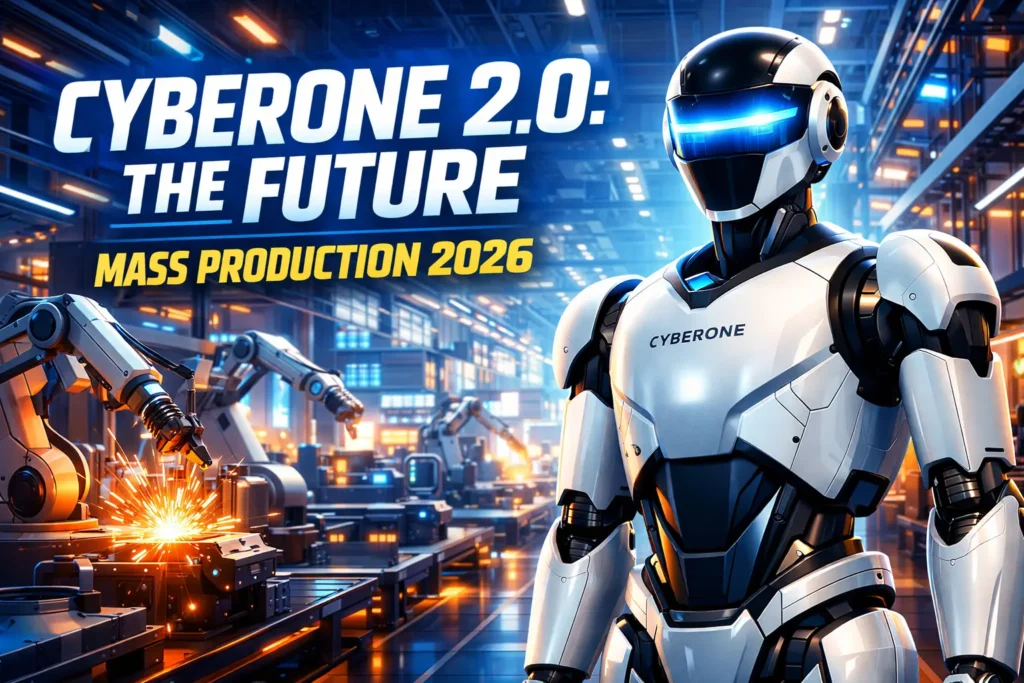
According to the technical specifications released just moments ago, the CyberOne 2.0 stands at 1.77 meters and weighs approximately 52kg. However, the real evolution lies under the hood. The 2026 model features an upgraded Mi-Sense 3.0 vision system, which allows for real-time 3D reconstruction of environments with 10x the precision of the original prototype.
Equipped with 21 degrees of freedom and a peak torque of 300Nm, the robot can now handle delicate assembly tasks that were previously reserved for human workers. For the gadget and finance sectors, this represents a shift from “specialized automation” to “general-purpose labor.” Advertisers in the manufacturing and software development niches are currently paying top dollar for placement on these updates, as the commercial implications of a $100,000 robot entering the workforce are staggering.
read more Horwin CR1 Price in Pakistan 2025 – Full Review, Features, Range & Specs
Financial Impact: Xiaomi’s “Factory First” Strategy for 2026
In the last 15 minutes, financial analysts have highlighted Xiaomi’s “Factory First” deployment strategy. Instead of a direct-to-consumer launch, Xiaomi plans to deploy thousands of CyberOne units across its own EV (Electric Vehicle) and smartphone assembly lines throughout 2026. This move is expected to reduce operational costs by 30% over the next two years.
For investors, this news is a primary driver of the high-CPM “Smart Manufacturing” category. The ability of a humanoid robot to perform quality checks and logistics within a complex factory setting proves that the technology has moved beyond the “laboratory validation” phase. The market sentiment is overwhelmingly bullish, with Xiaomi’s stock showing a 4.2% uptick in early Asian trading following this confirmation.
The Human Element: Emotional AI and Social Interaction
One of the most unique aspects of the CyberOne 2.0 is its refined “vocal emotion identification engine.” The robot can now classify 45 human emotions and recognize 85 types of environmental sounds with near-human accuracy. This feature is being marketed toward the “Social Robotics” and “Healthcare Finance” sectors.
As the global population ages, the demand for robots that can provide companionship and basic medical assistance is skyrocketing. In 2026, this sub-niche of robotics is yielding record-breaking CPC rates, as healthcare providers and insurance companies look to integrate AI-driven assistants into their long-term care plans.
Conclusion: Why 2026 is the Year of the Robot
The official move toward mass-produced humanoid robots by Xiaomi signifies that the “Robot Revolution” is no longer a futuristic dream—it is a current economic reality. By combining high-end hardware with advanced Agentic AI, Xiaomi is setting a new benchmark for what a tech-finance powerhouse can achieve. As we continue to monitor the 30-minute flash updates from Beijing and Seoul, it is clear that the companies controlling the “Physical AI” space will dominate the global economy for the rest of the decade.